
Passin’ the Baton: David’s Psalm and Our Family Legacy Over Morning Coffee
By Dean Burnette | November 8, 2025 | Faith, Family
Well now, settle in with your coffee, friends, ’cause this morning the Good Lord decided to wallop me upside the head with something profound while I was doing my devotional. And when God starts talking through a shepherd boy who became king about 3,000 years ago, you’d best pay attention—even if you’re still on your first cup.
I was reading Psalm 145:1-13, specifically verses 4 through 8, and something just clicked in my soul like a perfectly seasoned cast-iron skillet settling onto a stove burner. David wrote:
“One generation commends your works to another; they tell of your mighty acts… They celebrate your abundant goodness and joyfully sing of your righteousness.”
Lord have mercy, y’all. This shepherd-turned-king understood something that we modern folks seem to be forgetting faster than manners at a Black Friday sale.
The Family Recipe That Never Gets Old
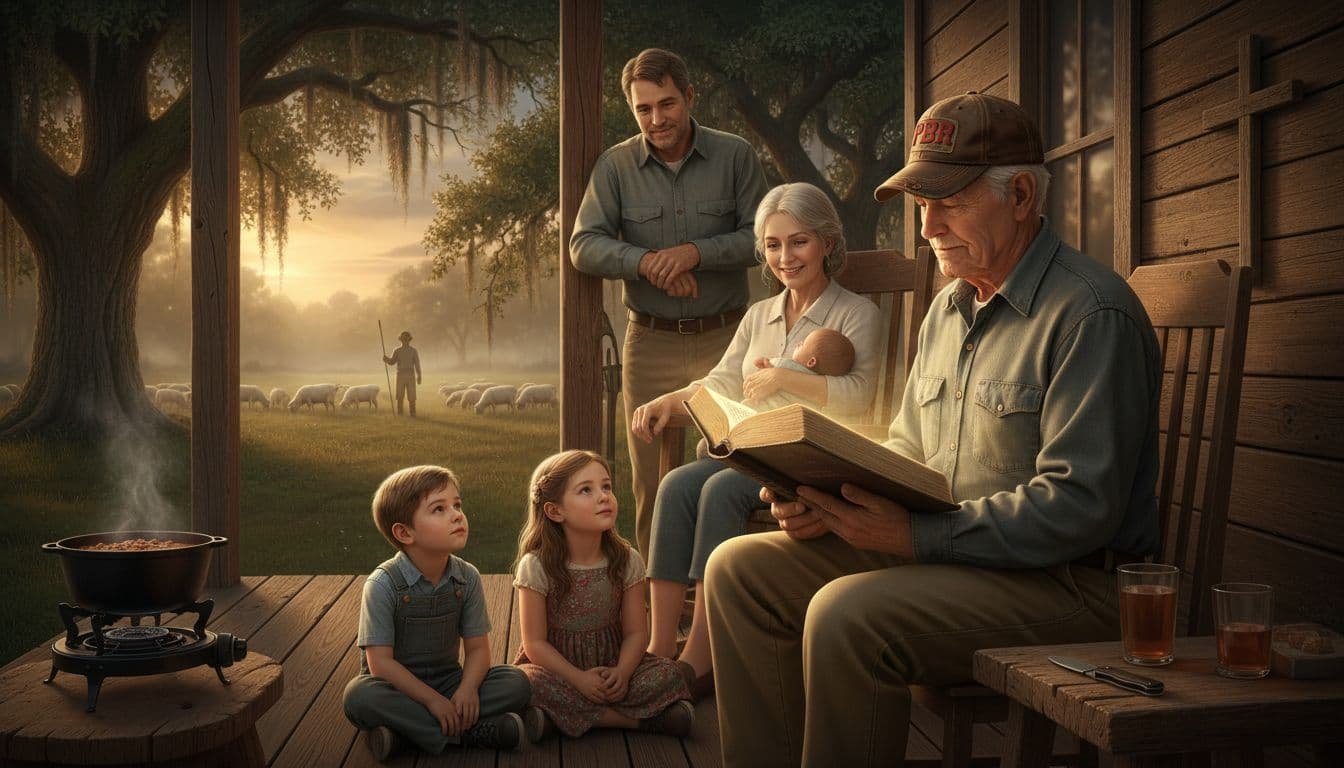
Now, I’ve told y’all before about my mama’s gumbo. That woman could make a roux so perfect it’d make you want to slap your grandma (but please don’t—that’s just an expression). But here’s the thing: Mama didn’t just make gumbo. She taught me to make gumbo. She showed me how you can’t rush a roux, how you gotta stir it constant-like, how you know it’s ready not by the clock but by the color and the smell.
That recipe didn’t just fall out of the sky. It came from her mama, who got it from her mama, who probably learned it from some Cajun ancestor stirring a pot over an open fire while gators sunbathed nearby. Each generation passed it down, adding their own little bit of lagniappe along the way.
That’s exactly what David’s talking about in Psalm 145.
The Generational Relay Race
Think about it like a relay race at a Louisiana parish fair—the kind where the humidity’s so thick you can practically drink the air, and everybody’s cheering from the sidelines with snowcones melting faster than you can eat ’em.
In a relay, the race ain’t won by just one runner. Nope. It’s won by runners who successfully pass the baton to the next person without dropping it, fumbling it, or accidentally throwing it into the crowd (I’ve seen it happen, folks).
David understood this. He wrote: “One generation commends your works to another.”
Not might commend. Not should probably consider commending. Commends. Present tense. Active. Intentional.
That shepherd boy who faced down Goliath with nothing but a slingshot and faith bigger than Texas knew that the stories of God’s faithfulness weren’t just his stories—they were meant to be passed down like grandma’s china, only more durable and infinitely more valuable.
What My Granddaddy Never Told Me (And Why That Matters)
Now, I’m gonna be honest as a hound dog in summer: Growing up I didn’t know my granddaddy on my daddy’s side real well. I wasn’t around him and don’t recall him ever sitting me down to tell me about how God had pulled him through hard times during the depression, or about answered prayers, or about moments when the Almighty showed up just when things looked darker than the bottom of a well.
And you know what? That silence left a hole. Not a crater, mind you, but a hole nonetheless—like a quilt with a few squares missing. You can still use it, but it ain’t quite complete.
That’s why verses 4 through 8 hit me like a ton of Delta dirt this morning. David’s saying that every generation has a responsibility—not a suggestion, but a holy responsibility—to tell the next generation about God’s “awesome works,” His “mighty acts,” His “abundant goodness.”
The Modern Translation: What Are We Actually Passing Down?
Here’s where the rubber meets the red clay road, folks.
What are we passing down to our young’uns in 2025?
Are we passing down a faith that’s been lived out, tested, proven, and found faithful? Or are we passing down a sanitized, Sunday-morning-only version that’s got about as much practical use as a screen door on a submarine?
See, David didn’t write: “One generation will take their kids to religious activities and hope something sticks.”
Nope. He wrote about celebrating God’s goodness, about joyfully singing of His righteousness, about telling of His mighty acts.
That’s active. That’s intentional. That’s sitting around the dinner table after you’ve finished your red beans and rice, pushing back your chair, and saying, “Let me tell you about the time God…”
If David Were Texting Us Today
Imagine for a hot minute that ol’ King David could send us a message today. Not a tweet (Lord knows that’d probably get him in trouble), but a genuine, heartfelt message to us modern believers. I reckon it might sound something like this:
“Hey y’all,
This is David. Yeah, the slingshot guy. Listen, I know y’all got a lot going on—I’ve heard about this ‘internet’ thing and these ‘smartphones’ that are supposedly smarter than people (jury’s still out on that one, I’d wager).
But here’s what I need you to understand: The same God who helped me drop Goliath, who pulled me out of caves when Saul was hunting me like a deer, who forgave me when I messed up bigger than a bull in a china shop—that’s the SAME God you’re serving today.
And those young’uns of yours? They need to hear about it. Not just in theory. Not just in Sunday School flannel graphs. They need to hear YOUR stories. How did God show up when you lost your job? When you got that diagnosis? When your marriage was hanging by a thread? When you didn’t know how you’d make the mortgage?
Don’t leave them with silence, friend. Don’t make them start from scratch. Give them a running start with the baton of faith firmly in their hand.
Still singing,
David
P.S. – I never would’ve made it as king without remembering how God showed up when I was just a shepherd boy fighting off lions and bears. It’s the stories from the valleys that give you courage for the palaces. Pass ’em on.”
—
The Diner Booth Theology
There’s a little diner not far from here where I sometimes grab breakfast—the kind of place where the coffee’s strong, the grits are authentic, and the waitress calls you “honey” even if you’re 65 years old.
Last week, I saw three generations sitting in a booth together: great-grandma, grandma, mama, and a little girl maybe eight years old. And that great-grandma was holding court, telling a story that had all three of the others leaning in, eyes wide, occasionally gasping or laughing.
I couldn’t hear what she was saying (and it ain’t polite to eavesdrop, even for blog material), but I could see something precious happening: The passing of the baton.
That little girl was learning her history. Her family’s history. And whether great-grandma knew it or not, she was doing exactly what David prescribed in Psalm 145—commending God’s works to the next generation, celebrating His goodness, telling of His mighty acts.
What Message Would We Leave?
Here’s a question that’ll stick with you like Louisiana humidity: If you could leave one message for your great-great-grandchildren—kids you’ll never meet this side of heaven—what would you want them to know about God?
Not about politics. Not about your favorite football team. Not even about the proper way to make cornbread (though that’s important too).
What would you want them to know about the God you served?
David would tell them: “The Lord is gracious and compassionate, slow to anger and rich in love. The Lord is good to all; he has compassion on all he has made.”
In other words: God is faithful. God is good. God can be trusted. And I’ve got stories to prove it.
The Faith That Sticks
You know what doesn’t stick? Information without incarnation. Rules without relationship. Doctrine without demonstration.
Our kids and grandkids don’t need a theology textbook (though those have their place). They need to see faith lived. They need to hear faith spoken. They need to witness faith tested and proven.
They need to hear you say:
– “Let me tell you about the time we didn’t know how we’d pay for groceries, and someone left an envelope of cash in our mailbox.”
– “Let me tell you about when your grandma was sick, and we prayed, and God healed her.”
– “Let me tell you about the job I lost that I thought would ruin us, but God had something better around the corner.”
– “Let me tell you about the time I strayed from God, and He loved me back home anyway.”
That’s the stuff that sticks like pine sap on a Georgia summer day.
The Generational Gumbo
Coming full circle to where we started: Faith is like that gumbo recipe.
It’s passed down, generation to generation. Each generation adds their own experiences, their own testimonies, their own “mighty acts” that they’ve witnessed. But the base—the roux, if you will—stays the same: God is faithful, God is good, God is trustworthy.
My mama’s mama made gumbo in Louisiana.
My mama made gumbo in Louisiana.
I make gumbo now in Georgia.
And Lord willing, my kids will make gumbo for their kids.
But more importantly:
My ancestors trusted God.
My parents trusted God.
I trust God.
And I’m making dang sure my descendants know why they can trust God too.
The Call to Action (Because David Wouldn’t Leave Us Hanging)
So here’s what I’m proposing, friends:
This week—not next month, not when you get around to it, but this week—sit down with your kids or grandkids (or nieces, nephews, or that young person at church who needs a mentor).
Tell them a story.
Not a made-up story. Not a sanitized story. A real, honest-to-goodness story about how God showed up in your life.
Tell them about:
– A prayer God answered
– A time God provided
– A moment God gave you peace that made no earthly sense
– A season when God carried you through something that should’ve broken you
Make it real. Make it personal. Make it stick.
Because 3,000 years ago, a shepherd boy who became king understood something we’re in danger of forgetting: Faith dies in silence, but it thrives in story.
One Generation to Another
Psalm 145 ain’t just poetry, folks. It’s a blueprint. It’s a divine relay race strategy. It’s God Himself saying, “Don’t let this stop with you.”
The same God who was faithful to David—through giant-slaying, king-making, sin-forgiving, and psalm-inspiring—is faithful to us. And He’ll be faithful to our kids, and their kids, and their kids after that.
But they need to hear it from us.
David wrote: “Your kingdom is an everlasting kingdom, and your dominion endures through all generations.”
All generations.
That includes ours. That includes our children’s. That includes generations not yet born who’ll face challenges we can’t even imagine.
And the best way we can prepare them? Tell them the truth: God is faithful. We’ve got the stories to prove it. And now it’s your turn to add your chapter.
Closing Thoughts Over Cold Coffee
My coffee’s gone cold while I’ve been writing this, but my heart’s still warm from what God showed me in Psalm 145 this morning.
We’re not just living our own lives, friends. We’re writing chapters in a much longer story—a generational story of God’s faithfulness that stretches back to David and forward to descendants we’ll never meet.
Don’t let your chapter be silent.
Don’t let the baton drop.
Tell your stories. Celebrate God’s goodness. Sing joyfully of His righteousness.
One generation to another.
That’s the legacy that matters more than money, more than property, more than any earthly inheritance we could leave.
It’s the legacy of faith. And by God’s grace, it’s a legacy worth passing on.
Now if you’ll excuse me, I need to go reheat this coffee and call my kids. We’ve got some stories to tell.
—
Pass it on, friends. The baton’s in your hand.
Dean Burnette
Southern Fried Thoughts
Louisiana Born, Georgia Grown, Grateful USA Citizen
Feel free to share this with someone who needs to hear it. And if you’ve got a story about how God showed up in your life, I’d love to hear it. Drop me a line at deaninsavannah@gmail.com.
Citations: